
The best evidence on traditional workplace wellness is not encouraging.
Song and Baicker’s randomized controlled trial, published in JAMA in 2019, followed roughly 33,000 employees across 160 worksites, with 20 sites randomized to receive the program. After eighteen months it found changes in self-reported health behaviors but no significant effect on clinical measures, health spending, absenteeism, performance or tenure. The Illinois Workplace Wellness Study, also randomized, reached broadly similar conclusions.
The usual reading of those results is that wellness does not work. The better reading is that these programs are used almost entirely by people who were already healthy, which means the population actually driving cost never participates at all.
Why do wellness programs fail to produce a return?
Because the people who enroll are not the people generating the cost.
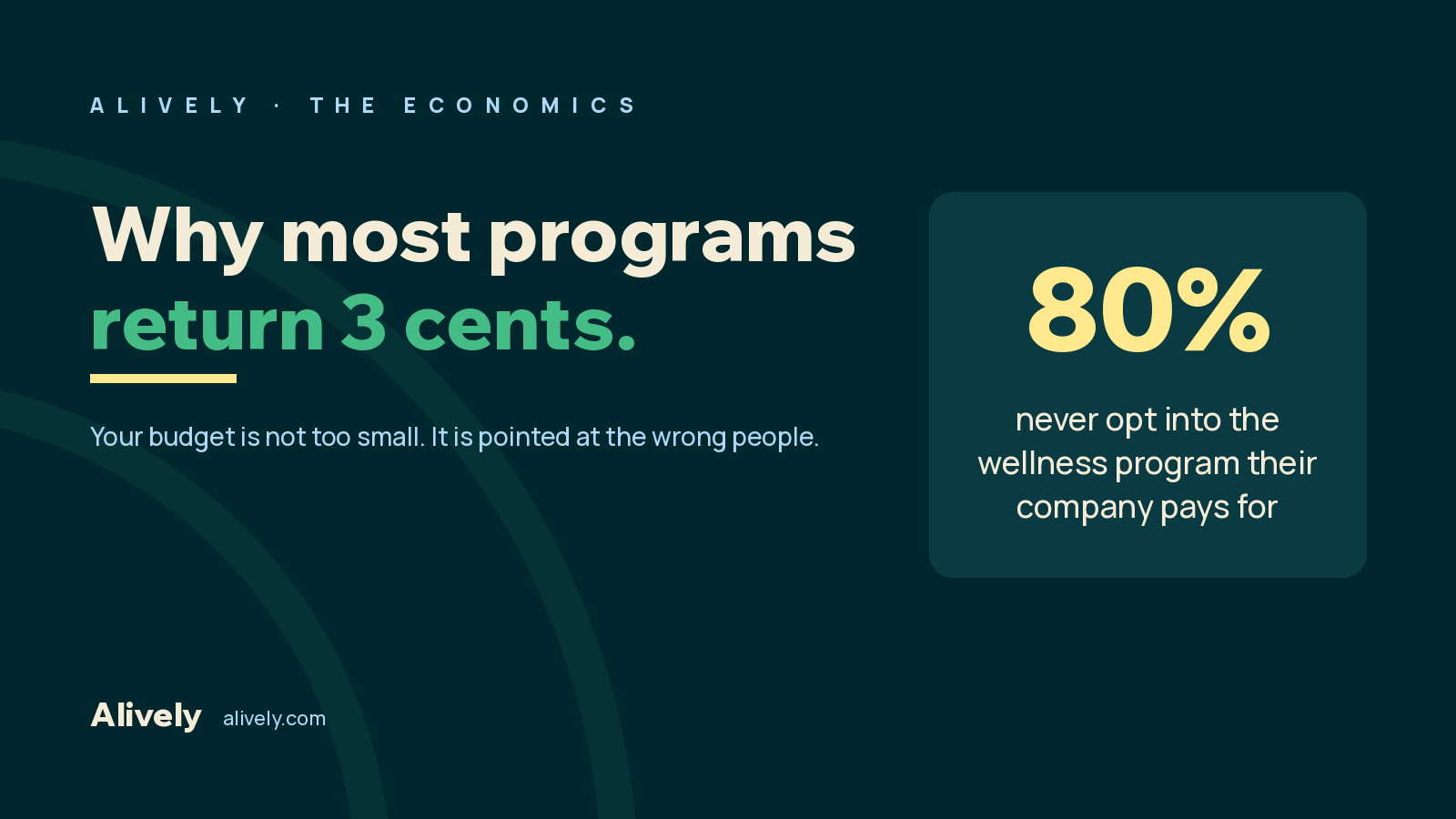
Typical engagement in a traditional corporate wellness program runs somewhere between 20% and 30%, and the composition of that group is the problem rather than its size. The employees who sign up for the step challenge, book the biometric screening and download the meditation app are disproportionately the employees who were already exercising, already sleeping, and already managing their health.
You are not changing behavior. You are subsidizing behavior that already existed.
Meanwhile the majority who never engage are the group whose health drives claims, absence and lost productivity. A program that reaches everyone except them can be well designed, well marketed and genuinely liked, and still return nothing measurable.
What is the frozen 80%?
The frozen 80% is the majority of any workforce that never meaningfully engages with a wellness offering.
They are not hostile to their own health. They are busy, tired, and facing a menu of twenty options with no indication of which one matters for them specifically. Choice paralysis is a well-documented effect, and a wellness portal is close to a perfect environment for producing it.
This group is where the entire available return sits. Any honest ROI conversation starts by asking whether a program can reach them, because if it cannot, the rest of the analysis is arithmetic on a number that will be zero.
Why does adding more options make it worse?
Because more choice reduces action rather than increasing it.
The instinct when engagement is low is to add. More content, more challenges, more vendors, more categories. It reliably fails, and there is a useful parallel from a different field: Deloitte’s research on enterprise AI adoption found that bolt-on deployments returned roughly 3% while end-to-end redesigns returned closer to 30%. The lesson transfers. Adding a component to a system that was not designed around it produces a fraction of the return of designing the system properly.
A wellness mall is a bolt-on. It sits beside the work rather than changing anything about it.
Where does the return actually come from?
From reaching the people who are not currently reached, with one thing at a time.
The design principle that works is narrowness. Identify the single highest-impact action for a specific person, make it small enough that they will actually do it, and let the next thing follow once that one holds. Programs offering twenty options produce inaction. Programs offering one produce a start.
This is why engagement rate is a more honest leading indicator than any projected ROI figure. If a vendor cannot tell you what share of a comparable workforce is still active at ninety days, the ROI model is decoration.
What about the cost side?
Worth separating from the return side, because they are different questions.
Published surveys put corporate wellness spend between roughly $150 and more than $1,200 per employee per year, with most of the variance driven by incentives and internal staff time rather than platform fees. Our page on corporate wellness program cost breaks that down.
The structural point is that a program which does not produce a return does not become a good investment by being cheap. It becomes a smaller bad one.
Does the funding structure change the ROI question?
It changes it substantially, because it removes the outlay from the equation.
A Section 125 wellness program is funded through payroll-tax efficiency rather than through a budget allocation. There is no implementation fee and no capital outlay, and it models to more than $750 per enrolled employee per year, sized against your own census. The arithmetic is here.
That does not make the engagement question go away. If nobody enrolls, there is no efficiency and no health return either. It does mean the downside is bounded in a way it is not with a purchased program, and that the health outcome is upside rather than the thing the entire business case depends on.
Does this differ for self-funded employers?
Yes, and materially.
A self-insured employer pays claims directly, so any reduction in claims reaches them in their own ledger rather than filtering back through a carrier’s renewal pricing over several years. That changes the second-order return on prevention meaningfully, which is why the case is clearest for self-funded companies. We cover that separately.
Frequently asked questions
Does corporate wellness actually work?
The randomized evidence on traditional programs, including Song and Baicker in JAMA (2019) and the Illinois Workplace Wellness Study, found no significant effect on clinical outcomes or health spending. The most credible explanation is participation composition rather than program content.
What is a typical wellness program engagement rate?
Traditional programs commonly report participation between 20% and 30%, weighted heavily toward employees who were already healthy.
How should we measure wellness program ROI?
Start with engagement among the population that was not previously engaged, and with ninety-day retention. Financial modeling built on projected outcomes for people who never enroll will not survive contact with reality.
Is there a wellness program with a guaranteed return?
No, and any vendor promising one is worth scrutinizing. What can be structured is the funding, so that the program does not require an outlay to begin with.
What to do next
Ask your current vendor for ninety-day retention among first-time participants. Not enrollment, not logins, not satisfaction. If they cannot produce it, that is the answer to the ROI question.
Then ask what a program costs you if the return is zero. We cover the cost side here. A structure funded by payroll-tax efficiency rather than a budget allocation changes that answer, because there was no outlay to recover.
Get the numbers modeled against your census. Ask for your numbers.
What to send your CFO
The randomized evidence on traditional workplace wellness, including Song and Baicker in JAMA (2019), found no significant effect on clinical outcomes or health spending. The most credible explanation is that participation skews heavily toward employees who were already healthy. Any program we consider should be judged on whether it reaches the people who do not currently engage, and on what it costs us if it does not.
This page is educational and is not tax or legal advice. The plan structure and covered care behind the program are administered by Alively’s compliance partner; the Alively app is wellness software, not medical care. Employers should have the plan documents and supporting opinions reviewed by their own tax counsel before launch.