
Here is the whole calculation, with every input you can check against your own payroll file.
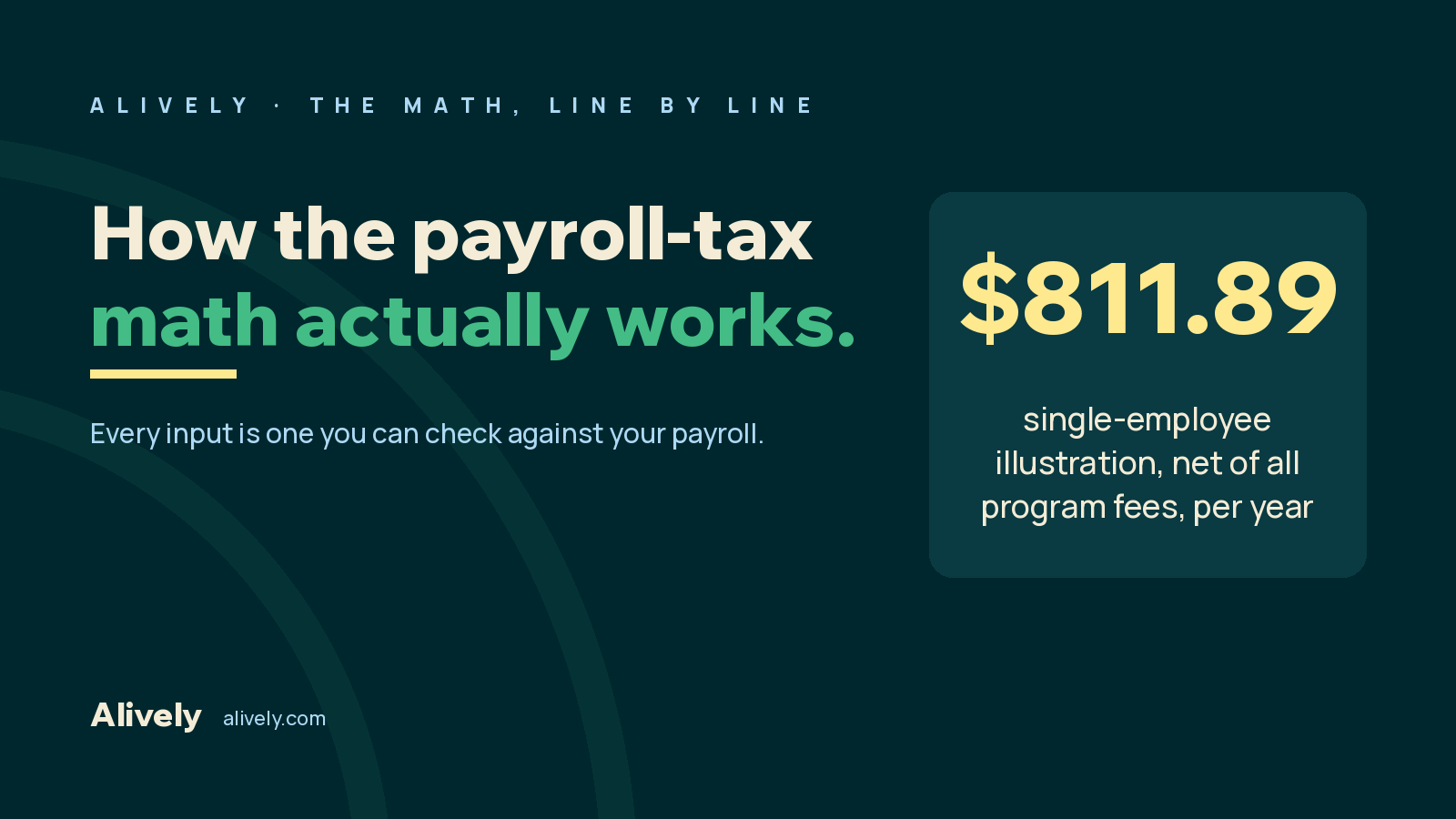
An enrolled employee makes a pre-tax election of $1,355 a month, which is $16,260 a year. Because that amount is pre-tax, the employer no longer owes the 7.65% FICA match on it, which comes to $1,243.89 a year. Subtract the employer’s platform contribution of $36 a month, or $432 a year, and a single enrolled employee models to $811.89.
We plan at more than $750 rather than at $811.89. The reason why is the most important part of this page, and it is in the second section.
What is the employer calculation?
| Line | Amount |
|---|---|
| Employee pre-tax election | $1,355 / month · $16,260 / year |
| Employer FICA match no longer owed (7.65%) | $1,243.89 / year |
| Less employer platform contribution ($36 / month) | −$432.00 / year |
| Net payroll-tax efficiency, single-employee illustration | $811.89 / year |
| Employer capital outlay | $0 |
Every input is checkable. The election amount is set by the plan. The 7.65% is the standard employer FICA rate, 6.2% Social Security plus 1.45% Medicare. The contribution is contractual. There is nothing in this calculation you have to take on faith.
Why plan at $750 rather than $811.89?
Because employees above the Social Security wage base change the arithmetic, and a CFO will find that within ten minutes of looking.
The employer’s Social Security obligation stops at the annual wage base. For an enrolled employee earning above it, only the 1.45% Medicare portion applies, which is roughly $236 a year on the same election. That is less than the $432 employer contribution, so those employees run approximately $196 a year negative rather than positive.
Blended across a workforce, that pulls the average down:
| Share of enrolled employees above the wage base | Blended net per enrolled employee |
|---|---|
| 5% | ~$761 |
| 10% | ~$711 |
| 15% | ~$661 |
More than $750 holds while roughly 6% or less of the enrolled population sits above the wage base, which covers a normal workforce distribution. It does not hold for an executive-heavy eligible class, and we would rather tell you that here than have you discover it in month three.
This is why the number in our materials is a planning figure rather than a promise, and why the real number always comes from your census.
What does an employee see?
An illustration, on a stated set of assumptions, and their own numbers before they commit to anything.
Modeled on a $39,000 salary, at 8% federal, 6.20% Social Security, 1.45% Medicare and 3.88% state: the employee’s monthly take-home moves by approximately $107.63, or about $1,292 across a year.
That figure is an illustration and nothing more. Actual amounts vary by wage, state, filing status, elections and payroll configuration. Every employee sees their own before-and-after numbers in the enrollment portal, built on their own pay and net of every program line item, before they decide anything. That personal illustration is the number to trust, not an average from a website.
Where does the money actually come from?
From payroll-tax efficiency created by two separate plan functions, not from a transfer between them.
The first function is a pre-tax election under the Section 125 cafeteria plan, which lowers taxable wages. The second is reimbursement of documented Section 213(d) medical care under a Self-Insured Medical Expense Benefit Plan, capped by that plan document at $1,198 a month of documented value.
Those two functions are governed by different documents and do different jobs. Describing them as a single circular flow is both inaccurate and the fastest way to make a structure that works sound like one that does not.
What is the reimbursement cap?
$1,198 a month of documented value, set by the plan document.
The cap is a compliance feature rather than a limitation. Reimbursement follows care that was actually delivered and substantiated, up to a ceiling written into the plan. A structure with no cap and no substantiation is the kind of arrangement the IRS has challenged, and our compliance page covers what those rulings said.
What does the employer pay?
$36 per participating employee per month toward the platform, and nothing else.
There is no implementation fee and no capital outlay. Invoicing does not begin until cumulative net savings exceed the fee, with the metric and the baseline agreed with your finance team before the program starts.
How long until we see it?
The efficiency appears in the first payroll cycle after go-live, and it cannot be claimed retroactively.
Implementation runs four to six weeks from agreement to first adjusted payroll, with roughly three hours of your team’s time, concentrated around the census pull and payroll setup. Because savings begin at the first cycle rather than at signature, the calendar matters more than it looks.
The honest catch
Employees have to enroll and participate.
If nobody enrolls, there is no benefit to them and no efficiency for the employer. This is not a program that runs in the background whether people engage or not, and any model you build should use a realistic enrollment assumption rather than full participation.
Frequently asked questions
How much do employers actually save per employee?
The single-employee illustration is $811.89 a year. The planning figure is more than $750 per enrolled employee per year, which accounts for employees above the Social Security wage base. The real number is modeled from your census.
Is this a guarantee?
No. Every figure here is illustrative and depends on wages, eligibility, participation, elections and payroll configuration. We model against your own census before anyone commits to a number.
What is the employer’s cost?
$36 per participating employee per month toward the platform. No implementation fee, no capital outlay, and no invoice until cumulative net savings exceed the fee.
Does this reduce employee take-home pay?
Employees see their own before-and-after figures in the enrollment portal, net of every program line item, before they enroll. They decide based on their own numbers.
What happens with highly compensated employees?
Enrolled employees above the Social Security wage base carry only the 1.45% Medicare portion, which is less than the employer contribution, so they run modestly negative. On an executive-heavy eligible class this is worth modeling carefully, and it is a reasonable subject for the census conversation.
What to do next
Get this modeled against your census. Every figure on this page is an illustration until it is run on your own payroll file, your own eligible population and your own wage distribution. That takes us a short call and a census, and it costs nothing. Ask for your numbers.
Send it to finance with the assumptions attached. The Finance and Legal Pre-Read carries the same arithmetic in a form written for a CFO, including the wage-base effect above. Forward it rather than summarizing it.
What to send your CFO
The paste-ready version, if you are the one presenting it.
A pre-tax election of $1,355 a month removes the employer FICA match on that amount, $1,243.89 a year. Net of a $36 monthly platform contribution, the single-employee illustration is $811.89. We plan at more than $750 because employees above the Social Security wage base carry only the Medicare portion and run slightly negative, so the blended figure is lower. There is no implementation fee and no capital outlay, and nothing is invoiced until cumulative net savings exceed the fee.
That last sentence is usually the one that ends the meeting.
This page is educational and is not tax or legal advice. The plan structure and covered care behind the program are administered by Alively’s compliance partner; the Alively app is wellness software, not medical care. Employers should have the plan documents and supporting opinions reviewed by their own tax counsel before launch.