
A Section 125 wellness program uses the cafeteria-plan framework in the Internal Revenue Code to fund preventive health benefits with pre-tax dollars.
You already run your company on Section 125. Every employer-sponsored health premium, every flexible spending account election and every payroll-deducted health savings account contribution flows through it. Enacted in the Revenue Act of 1978, it is one of the oldest and most heavily used provisions in the benefits world. Nobody calls those arrangements a loophole.
A Section 125 wellness program points that same existing framework at qualified preventive care rather than at insurance premiums. Nothing exotic, and nothing new. The framework is already there.
How does a Section 125 wellness program work?
Two plan documents doing two different jobs.
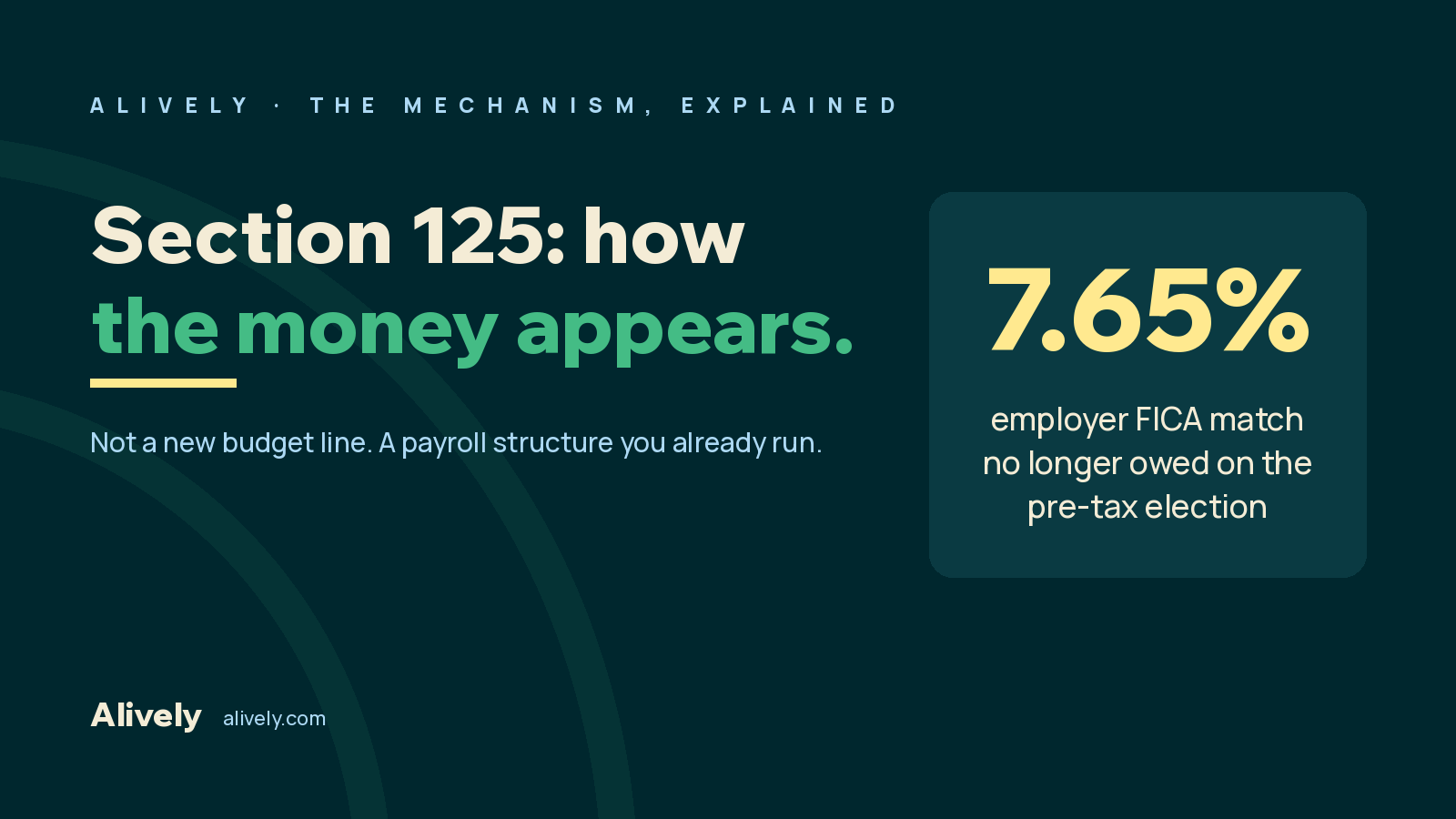
The first is the Section 125 cafeteria plan. It allows an employee to make a pre-tax election toward a qualified medical-care benefit. Because the election is pre-tax, taxable wages drop, and payroll tax drops with them for both the employee and the employer.
The second is a Self-Insured Medical Expense Benefit Plan, operating under Treasury Regulation Section 1.105-11. It governs what care is covered and what gets reimbursed, up to a ceiling written into the plan document. Reimbursement follows documented medical care under Internal Revenue Code Section 213(d) that was actually delivered and substantiated.
Those are the only two required plan documents. Keeping them distinct matters, because the election and the reimbursement are separate functions with separate rules, and describing them as one circular flow is both wrong and the fastest way to make a sound structure sound suspicious.
What does an employee actually receive?
A real preventive-care benefit, plus a health platform.
The covered care is delivered under the plan and administered by our compliance partner. Alively is the engagement layer on top of it: an application that connects to whatever wearable someone already uses, or to one they select through the program, and identifies the single highest-impact thing that person can do for their health right now.
The design principle is deliberately narrow. One action at a time, small enough that people actually do it. Programs that offer twenty options tend to produce inaction, and inaction produces nothing.
How is a Section 125 wellness program funded?
Through payroll-tax efficiency, not through a new line in the benefits budget.
The pre-tax election reduces taxable wages, which reduces the employer’s FICA obligation on that amount. That efficiency is what funds the program. There is no implementation fee and no capital outlay, and it models to more than $750 per enrolled employee per year, always sized against your own census rather than an average.
The full calculation, every input, and an honest account of where the number gets smaller is on the math page. It is not repeated here.
Is this the same as our existing wellness vendor?
No, and the difference is structural rather than a matter of features.
A traditional wellness program is a purchased service. You pay for it, you hope people use it, and the return depends on engagement you cannot control. A Section 125 wellness program is a benefit plan. It is documented, administered, and funded by the payroll mechanics of the election itself.
It also sits alongside what you already run rather than replacing it. Major medical, flexible spending accounts, health savings accounts and existing wellness offerings are unaffected.
What is the catch?
Employees have to enroll and participate.
Enrollment takes about ten minutes and requires onboarding plus staying opted in to program communications. If people do not enroll, there is no benefit to them and no efficiency for the employer. That is the entire catch, and it is worth naming early rather than discovering it in month two.
There is one eligibility requirement worth knowing about at the outset: participation requires health coverage. It does not have to be your plan. Coverage through a spouse or a parent qualifies. Employees with no coverage at all need a minimum essential coverage plan before they can join, and sizing that population from your census on the first call is the step that most often determines the timeline.
What this is not
- Not a cash bonus, inducement or participation reward.
- Not a reimbursement of insurance premiums.
- Not a fixed payment made regardless of whether care occurs.
- Not a replacement for major medical coverage.
- Not a tax shelter. The exclusion follows a real benefit that employees actually receive.
If you want the detail on why that distinction matters and what the IRS has actually said, that is a separate page, and it is the one to hand your tax counsel.
What does implementation involve?
Roughly three hours of your team’s time across four to six weeks.
You provide an employee census once. Your payroll team loads a set of codes. A test payroll runs so everyone can see real numbers before anything reaches a live paycheck. Then enrollment communications go out, written for you to review and send.
The test payroll is usually the step finance cares about most, because it means nobody has to take the arithmetic on trust.
Frequently asked questions
What is a Section 125 wellness program?
A wellness benefit funded through the Section 125 cafeteria-plan framework, in which employees make pre-tax elections toward documented preventive medical care. The pre-tax treatment reduces taxable wages and the associated payroll tax for both the employee and the employer.
How is it funded?
Through payroll-tax efficiency created by the pre-tax election, rather than through a new budget allocation. There is no implementation fee and no capital outlay.
Is it legal?
Section 125 has been in the Internal Revenue Code since the Revenue Act of 1978. Whether a specific plan is compliant depends on whether it reimburses documented Section 213(d) care that was actually delivered and substantiated. Our compliance page covers what the IRS has challenged and why.
Does it affect employees’ FSA or HSA?
No. It is not competitive with other Section 125 elections, and eligibility is underwritten per employee.
Who has to be eligible?
Full-time W-2 employees with health coverage, which can be their own plan, a spouse’s or a parent’s. The eligible population is confirmed from your census.
How long does it take to set up?
Four to six weeks from agreement to the first adjusted payroll, with about three hours of internal time.
What to do next
Get the numbers run on your census. The modeled figure is meaningless until it is your figure. A short call and an employee census produces it, at no cost and no commitment. Ask for your numbers.
Send your finance team the pre-read. The Finance and Legal Pre-Read is written for a CFO and outside counsel. It is the document to forward when someone asks how this actually works.
Put your counsel on a call with our compliance partner. Twenty minutes live usually saves hours of document review, and getting it in early is better for everyone than getting it in late.
What to send your CFO
If you are the person who has to raise this internally, this is the paragraph to paste.
Employees make a pre-tax election toward documented preventive medical care. Taxable wages drop, and the employer FICA owed on that amount drops with them. That payroll-tax efficiency funds the program, so there is no implementation fee, no capital outlay and no new budget line. It models to more than $750 per enrolled employee per year, sized against our census. Employees have to enroll and participate for any of it to happen.
Naming the catch in your own summary is what makes the rest of it credible.
This page is educational and is not tax or legal advice. The plan structure and covered care behind the program are administered by Alively’s compliance partner; the Alively app is wellness software, not medical care. Employers should have the plan documents and supporting opinions reviewed by their own tax counsel before launch.