Most corporate wearable programs select one device for everybody, and most of them stall.
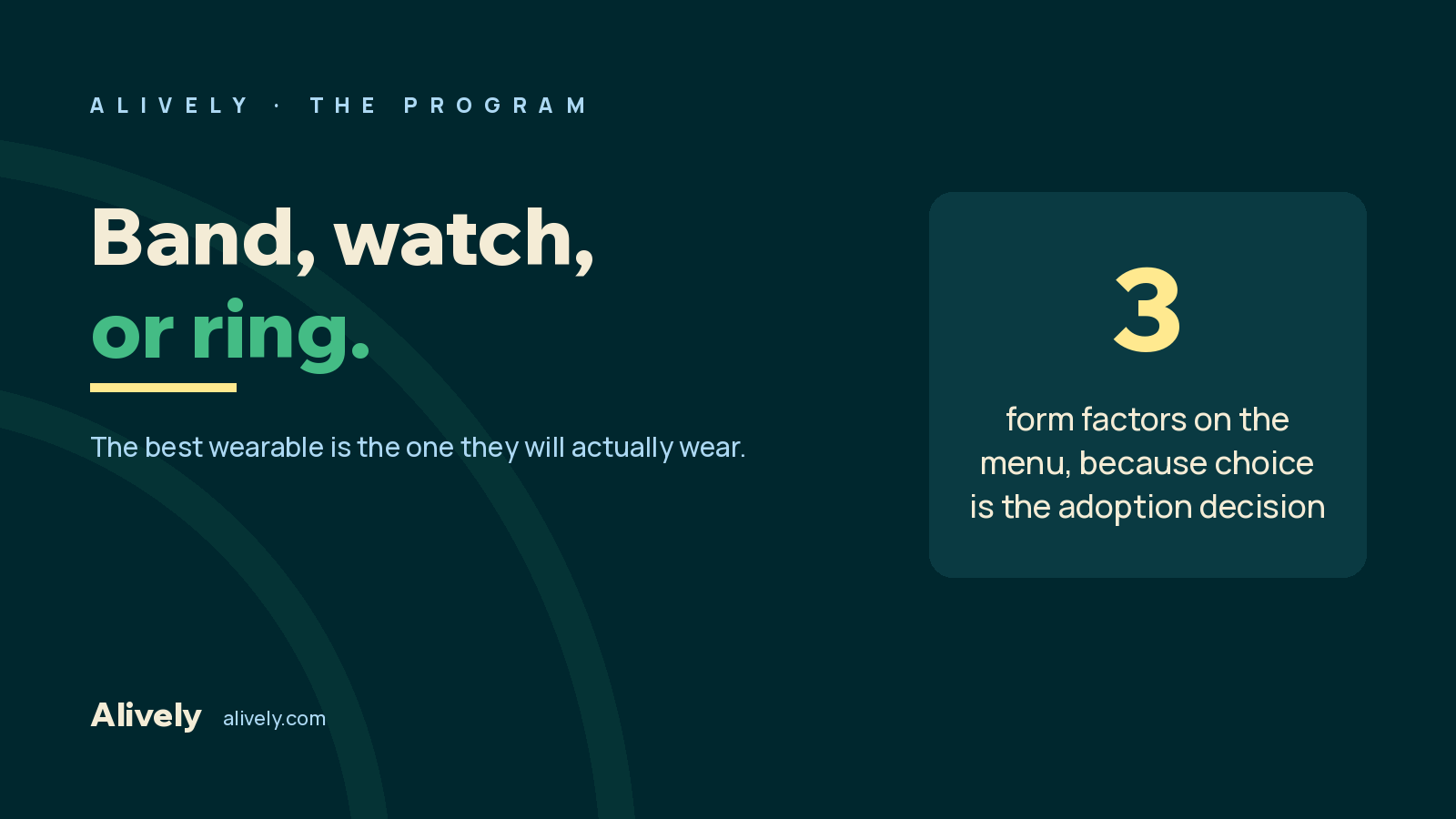
The reason is not the hardware. It is that a wrist or finger device is a personal object worn twenty-four hours a day, and adoption of a personal object somebody else selected is always lower than adoption of one the person chose. A program where each employee picks a band, a watch or a ring produces more sustained wear, and sustained wear is the only thing that produces usable data.
Why do single-device programs stall?
Because the objections are individual and a single device cannot answer them.
Some people will not wear anything on their wrist, because of work, because of preference, or because they already wear a watch they like. Some will not wear a ring. Some have a device they have used for years and have no interest in replacing it. Some object to charging another thing.
Each of those is a small objection, and each of them removes a person from the program permanently on day one. Standardizing on one device does not overcome the objections. It converts them into non-participation, and non-participation is invisible in a rollout report that only counts the people who said yes.
Does device choice actually change engagement?
It changes who starts, which is the part that compounds.
The failure mode in wearable programs is not people abandoning a device they chose. It is people never activating a device they did not choose. Once someone is wearing something they selected, the ongoing question becomes whether the program does anything useful with the data, which is a solvable problem. Getting a device onto someone who did not want that particular device is not solvable by feature work.
How does the device selection work?
Each enrolled employee receives one device, and chooses which one.
The menu covers bands, watches and rings. Alively funds the device and its subscription in every case, so the choice costs the employee nothing. What differs between the options is timing: the entry option can be claimed at launch, and premium options become claimable after more time on the program. That timing is set by us for a straightforward economic reason, which is that a device claimed on day one by someone who leaves in month two is a cost the program absorbs.
Employees who already own a wearable they like can connect it instead and skip the claim entirely. That is a first-class option rather than a fallback, and for a meaningful share of any workforce it is the right one.
Which devices work with the platform?
The platform is device-agnostic by design.
It connects to the major consumer wearables people already own, including watches, bands and rings from the manufacturers most commonly found in a workforce. The point is not which device somebody wears. The point is that the data arrives at all, and the surest way to guarantee it does not arrive is to require a specific piece of hardware.
What does the program do with the data?
It identifies one action, and then it gets out of the way.
Most wearable programs return more data. Charts, scores, trends, comparisons. For the people who are already engaged that is interesting. For everyone else it is another dashboard to ignore, and it is why data volume and behavior change are only loosely related.
The design principle here is the opposite. Ingest the data, identify the single highest-impact thing this specific person could do, and surface that one thing. Not twenty options, not a library, not a challenge. One. We call it a minimum enjoyable action, and the reason it is deliberately narrow is that anything more than one thing at a time reliably produces inaction.
Do employers see individual health data?
No. Employers see aggregated, anonymized trends only.
Individual data is never shared with the employer. Participation rates and population-level patterns are visible; one person’s numbers are not. This is worth stating clearly in your own launch communications, because it is the first question employees ask and the answer is better than most of them expect.
How does this fit the wider program?
The wearable is the input, not the product.
It sits inside a Section 125 wellness program, where the funding comes from payroll-tax efficiency rather than a budget line. The device makes the data available; the program is what turns the data into one thing worth doing.
What happens if someone leaves the company?
Payroll elections end and the program stops. There is no penalty and no clawback.
Frequently asked questions
Do employees have to use a specific wearable?
No. They choose one device from a menu covering bands, watches and rings, or they connect a device they already own.
Do employees get more than one device?
Each enrolled employee receives one device. The options differ by how long someone has been on the program before they can claim it, with the entry option available at launch.
What if an employee already has a wearable?
They connect it to the platform and skip the device claim. This is a fully supported path, not a workaround.
Can employers see individual health data?
No. Employers receive aggregated, anonymized reporting only.
Does the employee pay anything for the device?
No. Alively funds the device and its subscription, whichever option someone picks. What varies between options is when the device can be claimed, not what it costs the employee.
What to do next
Ask any wearable vendor what share of a comparable workforce is still wearing the device at ninety days. Not activation, not shipped units. Sustained wear is the only number that matters, and it is the one most vendors will not volunteer.
Confirm the device menu for your rollout. The options themselves are set per client, so the specific list for your workforce is worth confirming during implementation. What does not vary is the employee cost, which is nothing.
See how the wider program is funded. The Section 125 structure is here, and the arithmetic is here. Ask us to model it against your census.
This page is educational and is not tax or legal advice. The plan structure and covered care behind the program are administered by Alively’s compliance partner; the Alively app is wellness software, not medical care. Employers should have the plan documents and supporting opinions reviewed by their own tax counsel before launch.