
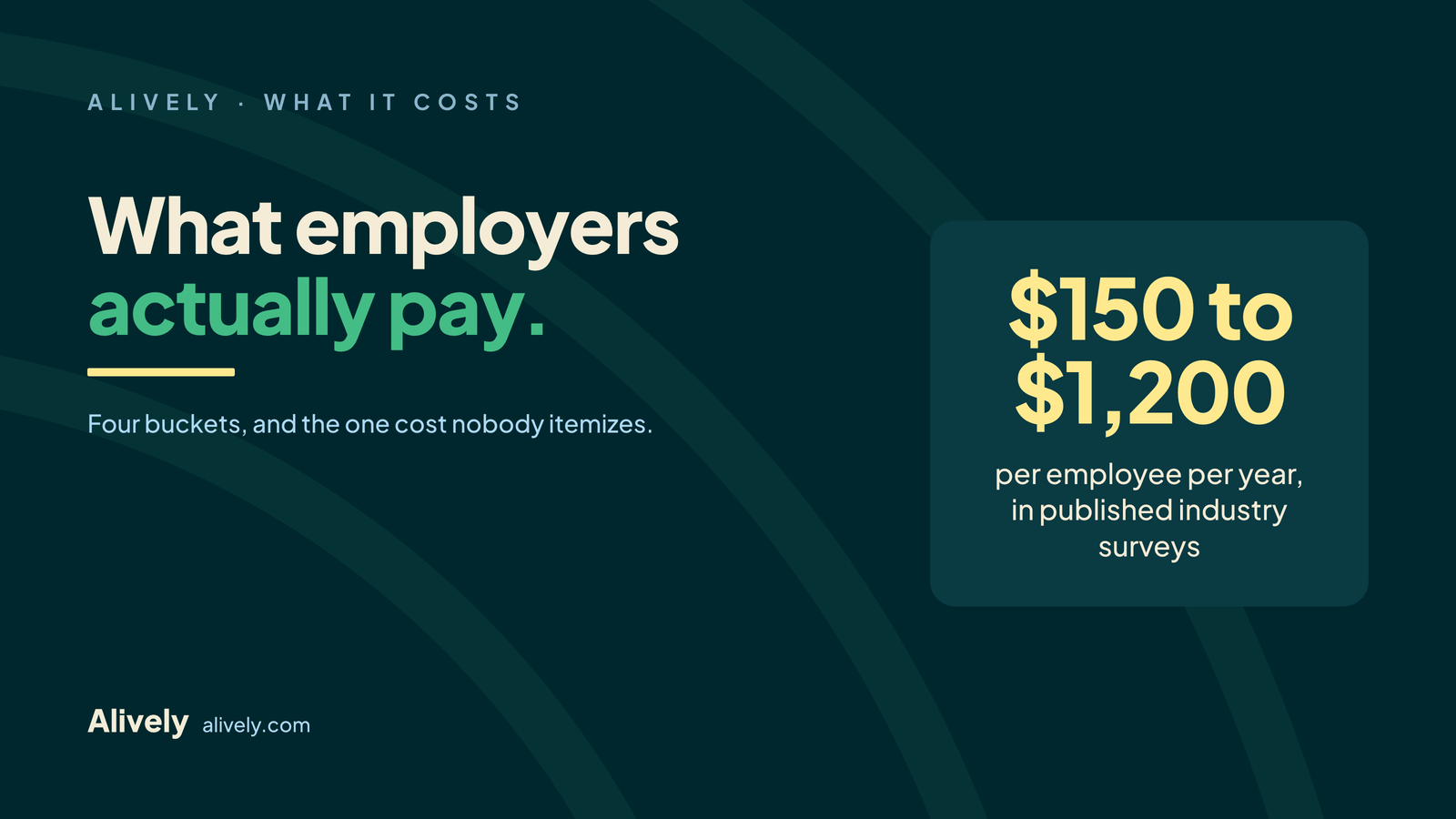
Published industry surveys put corporate wellness spend between roughly $150 and more than $1,200 per employee per year, with most programs clustering in the low hundreds once incentives are counted.
That range is wide because the number depends almost entirely on what is being counted. Platform fees are the visible cost and usually the smallest one. Incentives, screening and internal staff time are the three that rarely appear on an invoice and frequently exceed it.
Here is how the money actually breaks down, and how to read a quote.
What are the four cost buckets?
Platform and vendor fees. The line item on the invoice. Typically quoted per employee per month, and typically the number a vendor leads with. For a mid-market employer this often lands somewhere between a few dollars and around fifteen dollars per employee per month depending on scope.
Incentives. Frequently the largest single component and the one most often left out of internal comparisons. Gift cards, premium differentials, cash rewards and contribution credits are real spend. Programs that rely on incentives to drive participation are, by construction, buying participation.
Biometric screening and health assessments. Onsite events, lab work and vendor-administered assessments. Charged per participant, so cost scales with the engagement you were hoping for, which produces the uncomfortable position where success costs more.
Internal time. The HR and benefits hours spent selecting, launching, promoting, administering and reporting on the program. Nobody puts this on the invoice. It is real money anyway, and on a small benefits team it is frequently the binding constraint rather than the budget.
Stack the four and the survey range makes sense. A program that looks cheap at four dollars per employee per month is rarely cheap once incentives and staff time are included, and a comprehensive program can quietly pass $1,000 per employee per year.
Why do published cost figures vary so much?
Because surveys are not counting the same things.
Some report platform fees only. Some include incentives. Very few attempt to value internal administrative time. When you see a benchmark figure quoted without a definition of what it includes, it is not comparable to your own number, and it is not comparable to the next benchmark either.
The practical fix when evaluating a quote is to rebuild every option on the same four buckets before comparing anything.
How do you read a vendor quote?
Five questions, and the answers are more revealing than the price.
Is the fee per employee or per participant? Per-employee pricing means you pay for people who never log in. Per-participant pricing aligns cost with usage but makes budgeting harder.
Are incentives included or additional? Almost always additional. Ask what participation rate the quote assumes, because the incentive budget is derived from it.
What is the implementation fee, and is it waived conditionally? Waived-if-you-sign-by is a discount, not an absence of cost.
What is the minimum term, and what happens if we cancel? A twelve-month minimum on a program with 20% engagement is eleven months of paying for something nobody uses.
What internal time does this require, in hours, from whom? A vendor who cannot answer this specifically has not implemented enough times to know, or would rather you did not.
What is the cost of a program that does not work?
The full spend, plus the opportunity cost of the internal time, plus the credibility cost of launching something to your workforce that visibly goes nowhere.
That last one is rarely modeled and matters more than it looks. Employees notice when a program is announced with enthusiasm and quietly abandoned. The next thing you launch inherits that history, and re-earning attention is harder than earning it the first time.
This is the argument for evaluating engagement before evaluating price. A cheaper program that reaches nobody is not the better deal.
What should a program cost?
There is a defensible argument that the answer is nothing, and it is worth understanding rather than dismissing.
A wellness program funded through the Section 125 framework has no implementation fee and no capital outlay, because the funding comes from payroll-tax efficiency created by the plan mechanics rather than from a budget allocation. Modeled against a normal workforce it produces more than $750 per enrolled employee per year to the employer, with the calculation sized against your own census.
That is a different financial structure rather than a cheaper vendor, and it comes with its own requirements. The full arithmetic, including where the number gets smaller, is here, and the budget-line question is here.
Frequently asked questions
How much does a corporate wellness program cost per employee?
Published surveys report a range of roughly $150 to more than $1,200 per employee per year. The variance is driven mostly by incentive spend and by whether internal administrative time is counted at all.
What is the biggest hidden cost in a wellness program?
Incentives, followed by internal HR and benefits time. Neither appears on a vendor invoice, and together they frequently exceed the platform fee.
Is per-employee or per-participant pricing better?
Per-participant aligns cost with actual usage but makes budgeting less predictable. Per-employee is predictable but means paying for non-participants, which on a program with 25% engagement means paying four times the effective per-user rate.
Can a wellness program cost nothing?
A program funded through payroll-tax efficiency requires no implementation fee and no capital outlay. It does require employee enrollment and participation, and there is an employer platform contribution accounted for inside the net figure.
What to do next
Rebuild every quote you have on the same four buckets. Platform, incentives, screening, internal time. Most vendor comparisons fall apart at this step, and it takes an afternoon.
Ask each vendor what participation rate their quote assumes. The incentive budget is derived from it, and the number is rarely volunteered.
Then compare that total against a structure with no outlay at all. Ask us to model it against your census. It costs nothing and it gives you a real number to put beside the quotes.
This page is educational and is not tax or legal advice. The plan structure and covered care behind the program are administered by Alively’s compliance partner; the Alively app is wellness software, not medical care. Employers should have the plan documents and supporting opinions reviewed by their own tax counsel before launch.