
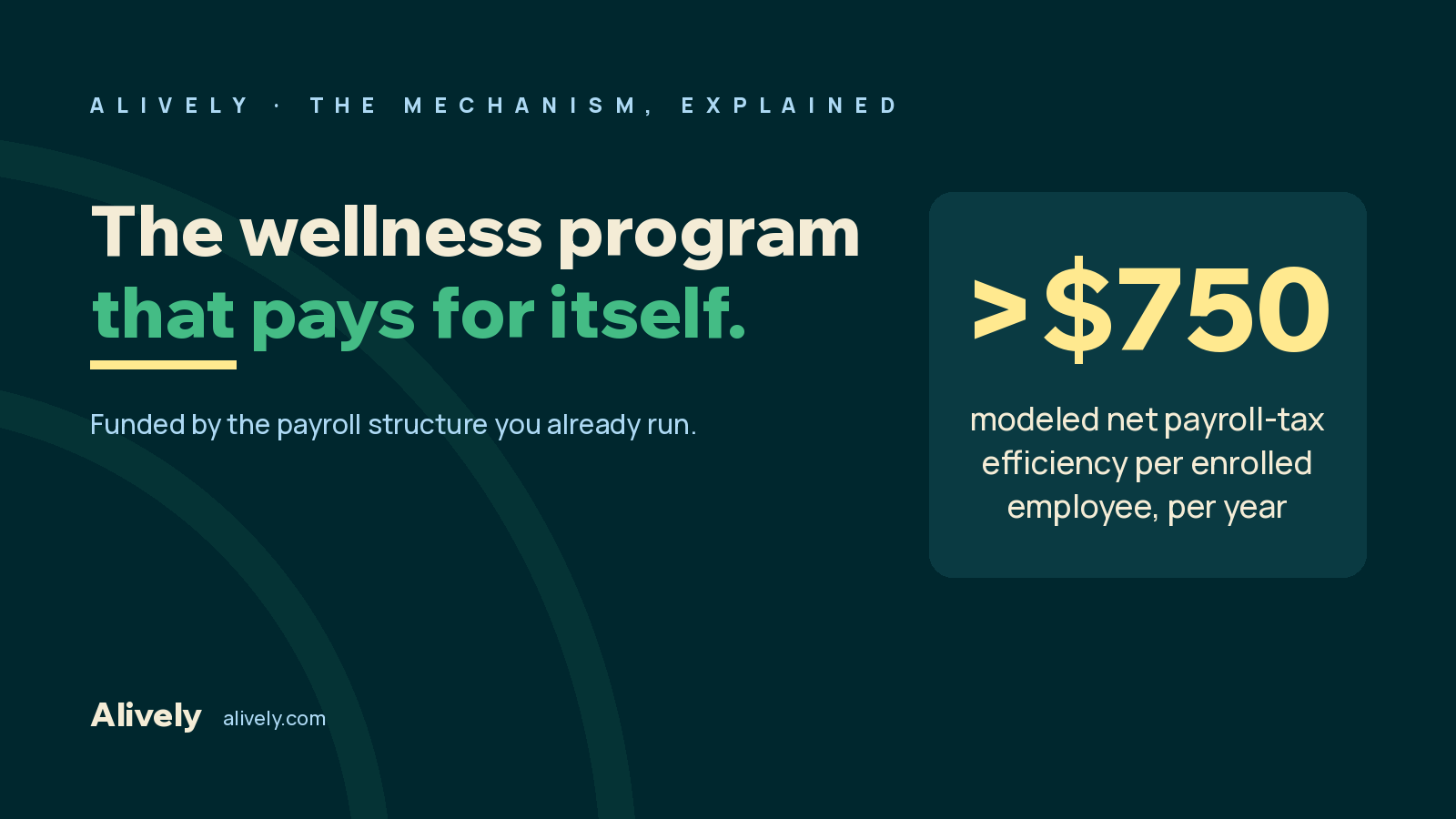
This program does not require a new line in your benefits budget.
There is no implementation fee, no capital outlay, and no invoice until your cumulative net savings exceed the fee. That is not a discount or a promotional period. It is a consequence of where the funding comes from: the payroll structure you already operate, rather than money you have to go and find.
The catch is real, and it is in the fourth section rather than buried at the end.
How can a wellness program pay for itself?
Because the funding is a by-product of the plan mechanics rather than a purchase.
When an employee makes a pre-tax election under a Section 125 cafeteria plan, taxable wages drop. The employer’s FICA obligation drops with them. That reduction is not a rebate, a credit or a transfer. It is simply payroll tax that is no longer owed on that portion of wages, and it is what funds the program.
You are not spending money and hoping to earn it back. There was never an outlay to earn back.
What does “pays for itself” actually mean here?
Three specific things, all of which you can check.
No implementation fee. Setup, plan documents, enrollment and payroll configuration are handled by the compliance partner administering the plan.
No capital outlay. Nothing is purchased up front and nothing is depreciated.
No invoice until savings exceed the fee. You and your finance team agree the metric and the baseline before the program starts. Until cumulative net savings clear the fee, no invoice is issued. The runway sits with us rather than with you.
The employer does contribute $36 per participating employee per month toward the platform. That figure is inside the net calculation, not on top of it, and the math page shows exactly where it lands.
Why is there no budget line?
Because the money never enters your budget in the first place.
A traditional wellness vendor sends an invoice, so someone has to find the money, defend it in a planning cycle, and justify it again next year. This does not work that way. The efficiency appears in payroll, which means the conversation with finance is about validating a calculation rather than approving a spend.
That is a materially different conversation, and it is usually a shorter one.
The honest catch
Employees have to enroll and participate. If they do not, there is no benefit to them and no efficiency for the employer.
Enrollment takes about ten minutes. It requires onboarding, and it requires staying opted in to program communications rather than unsubscribing from them. This is not a program that runs quietly in the background whether people engage or not.
There is a second requirement worth naming early. Participation requires health coverage. It does not have to be yours, since coverage through a spouse or a parent qualifies, but employees with no coverage at all need a minimum essential coverage plan before they can join. If a meaningful share of your workforce is uninsured today, that step is what determines your timeline, and it is sized from your census on the first call rather than guessed at.
Any model you build should use a realistic enrollment assumption rather than full participation.
What does the employee get out of it?
A preventive-care benefit, a health platform, and a wearable if they want one.
The covered care is delivered under the plan. Alively is the engagement layer: it connects to whatever wearable someone already uses, or to one they choose through the program, and surfaces one small action at a time rather than a menu of twenty.
Employees also see their own before-and-after payroll figures in the enrollment portal, built on their own pay and net of every program line item, before they decide anything. Nobody is asked to trust an average.
What this is not
- Not a discount, a rebate, or money returned.
- Not a cash bonus or participation reward.
- Not a reimbursement of insurance premiums.
- Not a promise about any individual’s take-home pay.
- Not a replacement for major medical coverage.
What would finance ask?
Four questions, in our experience, and all four have documents behind them.
Where does the funding come from, mechanically. What are the two plan documents and what does each govern. What happens if the IRS takes a different view, and who carries that. What does the calculation look like against our actual census.
The first three are covered on the mechanism page and the compliance page. The fourth is not something a website can answer, and we would rather model it from your census than publish a number and call it yours.
Frequently asked questions
Is there really no cost to the employer?
There is no implementation fee and no capital outlay, and no invoice until cumulative net savings exceed the fee. The employer contributes $36 per participating employee per month toward the platform, which is accounted for inside the net figure rather than added to it.
When do savings start?
At the first payroll cycle after go-live. They cannot be claimed retroactively, which is why implementation timing matters more than it appears.
What if we cancel?
There is no penalty and no clawback. Payroll elections end and the program stops.
How much internal time does this take?
About three hours across four to six weeks, concentrated around the census pull and payroll setup, then a light monthly touch.
Does this replace our current benefits?
No. It runs alongside major medical, flexible spending accounts, health savings accounts and any existing wellness offering.
What to do next
Get your own number before you take this anywhere. Ours is a planning figure. Yours comes from your census, your eligible population and your wage distribution, and it takes a short call to produce. Ask for your numbers.
Agree the baseline with finance up front. Because nothing is invoiced until cumulative net savings exceed the fee, your finance team sets the metric and the starting point before the program begins. That conversation is worth having early, and it is usually the one that makes the rest straightforward.
What to send your CFO
There is no implementation fee and no capital outlay. The program is funded by payroll-tax efficiency created by a pre-tax election, not by a budget allocation, and nothing is invoiced until our cumulative net savings exceed the fee, on a baseline we agree first. The catch is participation: employees have to enroll, and if they do not there is no benefit and no efficiency.
This page is educational and is not tax or legal advice. The plan structure and covered care behind the program are administered by Alively’s compliance partner; the Alively app is wellness software, not medical care. Employers should have the plan documents and supporting opinions reviewed by their own tax counsel before launch.