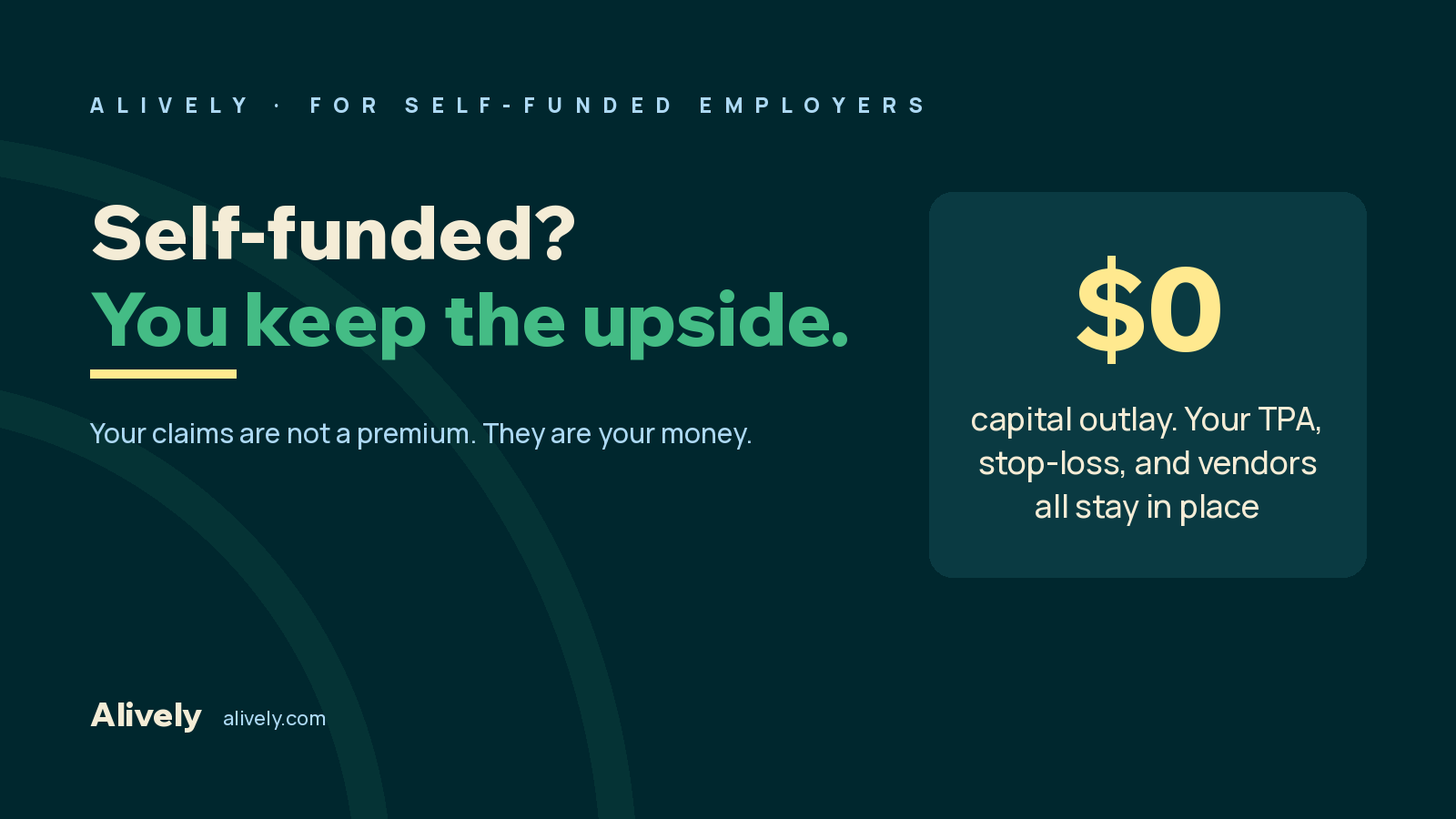
A self-funded employer pays claims directly, which changes the arithmetic of prevention.
When a fully insured employer reduces claims, the benefit reaches them slowly. It travels through the next renewal, filtered by a carrier’s pricing decisions, pooled with other groups, and arrives diluted if it arrives at all. A self-funded employer sees it in their own claims ledger, in the year it happens.
That is why the same wellness structure produces a different return depending on how the health plan is funded, and why self-funded employers are the clearest case for it.
Why do self-insured employers capture more of the upside?
Because there is no intermediary between the reduction and the balance sheet.
Under a fully insured arrangement the employer buys coverage at a price set in advance. Improved population health may influence next year’s rate, or the year after, and the employer never sees the underlying claims that produced the improvement. The savings are real but they are somebody else’s first.
Under a self-funded arrangement the employer is the payer. A claim avoided is a payment not made. The connection between prevention and money is direct, immediate and visible in data the employer already owns.
This is directional industry framing rather than a program guarantee, and it is worth stating as a position rather than a promise. But it is the reason benefits consultants consistently point self-funded groups at prevention first.
Where does the second-order return sit?
In claims trend, in stop-loss positioning, and in the data itself.
Claims trend. Self-funded employers manage to trend rather than to a premium. A program that moves the underlying health of the population affects the trajectory rather than a single year’s number, and trajectory is what compounds.
Stop-loss. Specific and aggregate stop-loss pricing responds to claims experience. A population with better experience is negotiating from a better position at renewal. This is a position, not a promise, and the magnitude depends entirely on the group.
Population data. Self-funded employers already receive aggregate claims reporting. Engagement data from a wellness program sits alongside it, and the combination is more useful than either alone for the group that is planning ahead.
How does the Section 125 structure fit under a self-funded plan?
It sits alongside it. The two are separate arrangements doing separate jobs.
The Section 125 cafeteria plan and the Self-Insured Medical Expense Benefit Plan govern pre-tax elections and reimbursement of documented preventive care. Your self-funded major medical plan continues to operate exactly as it does today. Neither replaces or modifies the other, and participation in one does not affect eligibility or coverage under the other.
One naming point causes recurring confusion and is worth clearing up. The Self-Insured Medical Expense Benefit Plan in this structure is a plan document about reimbursement of preventive care. It is not the same thing as your self-funded health plan, and the shared vocabulary is unfortunate. We explain the terminology here.
Is the funding mechanism different for self-funded employers?
No. The payroll-tax mechanics are identical.
The pre-tax election reduces taxable wages, the employer’s FICA obligation on that amount goes with it, and the structure models to more than $750 per enrolled employee per year against your own census. The full calculation is here.
What differs is not the funding. It is that a self-funded employer has a second, independent reason to care about whether the health outcome actually materializes, because they carry the claims. For a fully insured employer the health improvement is largely someone else’s benefit. For a self-funded one it is theirs.
What about employers planning to move to self-funding?
This is the group where the case is strongest and least often made.
An employer intending to self-fund in the next two to three years has a specific problem: they will be assuming claims risk on a population whose health they have not yet influenced. Starting a prevention program before the transition rather than after gives the population time to move, and gives the employer real engagement data to bring to the underwriting conversation.
Starting the year you self-fund is starting late.
What does it require?
The same as any employer, with one item that matters more here.
Participation requires health coverage, which for a self-funded employer usually means the plan you already offer. Employees who waive coverage, and there are usually more of them than expected, need coverage elsewhere or a minimum essential coverage plan before they can join.
Waiver populations are worth sizing carefully from the census on the first call. On a self-funded plan you often have limited visibility into whether waiver-takers carry coverage at all, and that visibility gap is both the eligibility constraint and, separately, something worth knowing.
Frequently asked questions
Is a wellness program more valuable for self-insured employers?
The payroll-tax efficiency is identical. The difference is that a self-funded employer captures any claims improvement directly rather than through a carrier’s renewal pricing, which gives them a second independent return that a fully insured employer largely does not receive.
Does this replace our self-funded health plan?
No. It is a separate arrangement that operates alongside your major medical plan and does not modify it.
Is the Self-Insured Medical Expense Benefit Plan the same as our self-funded plan?
No. Despite the similar name it is a plan document governing reimbursement of documented preventive care under Treasury Regulation Section 1.105-11. Your self-funded major medical plan is unrelated.
Will this reduce our stop-loss premium?
Stop-loss pricing responds to claims experience over time. Better experience improves your negotiating position at renewal. That is a position rather than a promise, and the effect depends on your group, your carrier and your history.
We are planning to self-fund in two years. Should we wait?
The argument runs the other way. Starting before the transition gives the population time to change and gives you engagement data to bring into underwriting.
What to do next
Size your waiver population from the census first. On a self-funded plan this is both the eligibility constraint and, separately, something worth knowing. It is the step that most often determines the timeline.
Get the payroll-tax figure modeled on your own numbers. Ask for your numbers.
Bring your stop-loss conversation forward. If you are approaching renewal, engagement data is worth having in hand before the conversation rather than after.
What to send your CFO
The payroll-tax mechanics are the same for any employer. What differs for us is that we pay claims directly, so any improvement in population health reaches our own ledger rather than a carrier’s renewal pricing. The program itself has no implementation fee and no capital outlay, and models to more than $750 per enrolled employee per year against our census.
This page is educational and is not tax or legal advice. The plan structure and covered care behind the program are administered by Alively’s compliance partner; the Alively app is wellness software, not medical care. Employers should have the plan documents and supporting opinions reviewed by their own tax counsel before launch.