
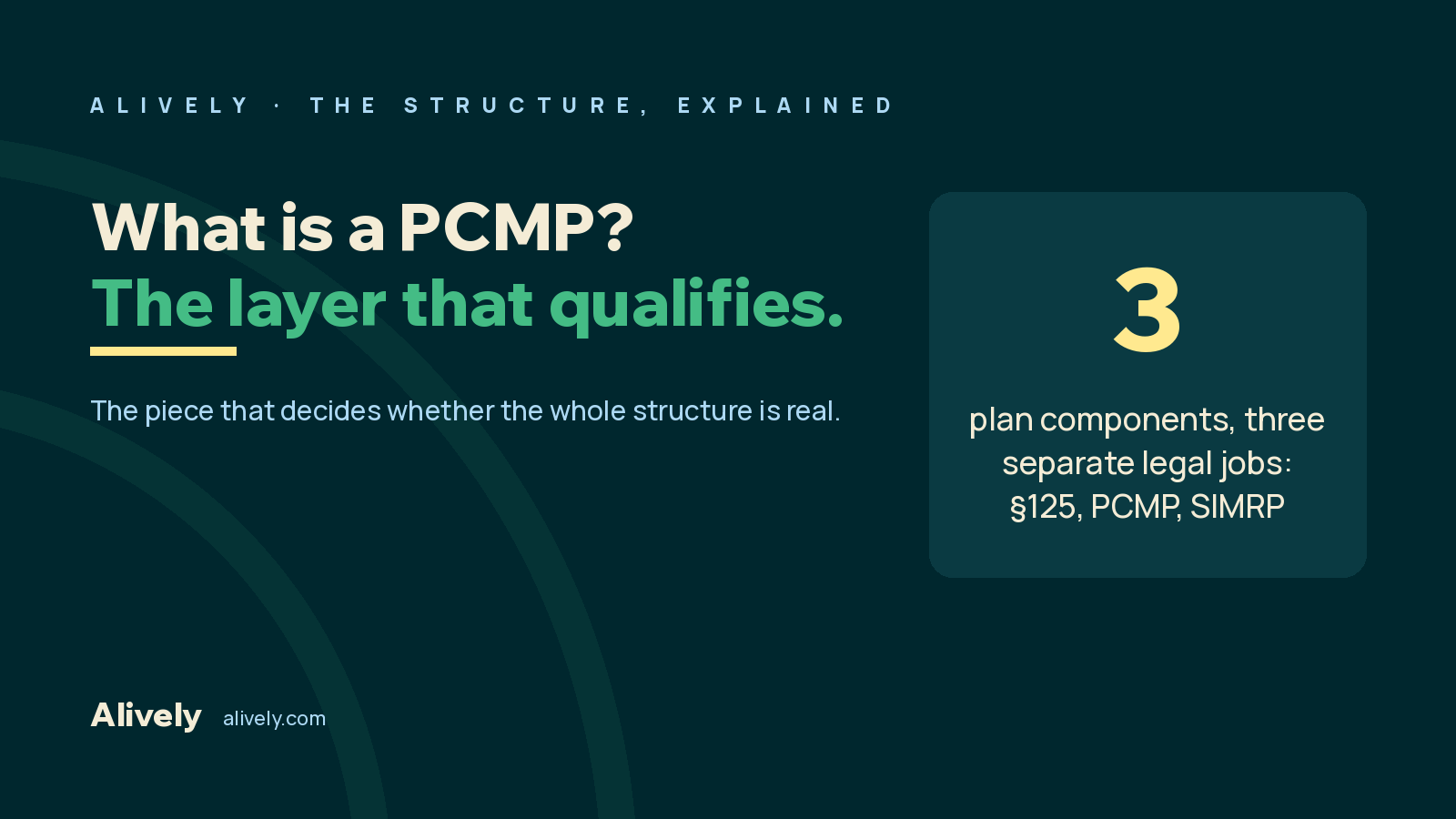
If you have been evaluating a net-zero-cost wellness benefit, you have probably seen three acronyms travel together: Section 125, SIMRP, and PCMP. The first two get most of the attention. But the PCMP, or preventive care management program, is the piece that determines whether the whole structure is real. It is the plan component that documents the actual medical care, and everything else in the mechanism depends on it.
This page defines the PCMP in plain English, explains its role inside the Section 125 / SIMRP structure, and covers what a well-built one has to do. It is the third leg of a three-legged stool, so if you have not read the SIMRP explainer or the Section 125 overview, those cover the other two.
The plain-English definition
A preventive care management program (you will also see “preventative care management plan,” same thing) is a formal, written employer-sponsored program that delivers and documents preventive medical care as defined by IRC Section 213(d).
That one sentence is doing three jobs, so take them one at a time.
Delivers: the PCMP is the care itself. In a serious program that means real, individualized preventive support for the conditions that actually drive claims, guided over time by the plan administrator. In Alively’s program that is our compliance partner, with a decade of experience doing this at scale. Not a poster campaign. Not a gym discount.
Documents: the PCMP is also the paper trail. It establishes, in written plan documents, that the program’s components qualify as Section 213(d) medical care, meaning amounts paid for the diagnosis, cure, mitigation, treatment, or prevention of disease. Prevention is in the statute itself.
Program: it is a defined plan with eligibility rules, a covered-services schedule, and records. Enrollment dates, outreach logs, program access, check-ins. Records that can be produced under audit, at the plan and administrator level.
How a PCMP fits the Section 125 structure
The full mechanism has three components, and each one has a separate legal role. That separation is not bureaucratic decoration. It is the design.
The Section 125 cafeteria plan is the contribution mechanism. Employees make a pre-tax election toward the documented medical-care benefit. Section 125 has been in the Code since 1978.
The PCMP is the qualification layer. It documents that what employees are electing into is bona fide 213(d) preventive medical care, which is what substantiates the pre-tax election in the first place.
The SIMRP, under Treasury Regulation 1.105-11, is the reimbursement layer. It reimburses eligible, substantiated, unreimbursed 213(d) expenses under its own plan documents and its own schedule.
Take the PCMP out and the structure collapses. A Section 125 election with no documented medical care behind it is exactly the pattern the IRS has challenged: compensation relabeled as tax-free wellness. The arrangements flagged in Rev. Rul. 2002-3, Rev. Rul. 2002-80, and CCA 202323006 share a defining failure, and it is a PCMP-shaped hole: flat payouts, no bona fide 213(d) care delivered, no substantiation. The PCMP is the difference between a documented medical-care program and a payroll maneuver. The full treatment of that question lives in the compliance explainer.
When all three components are in place and properly administered, the economics arrive as a byproduct. Pre-tax elections lower taxable wages, which removes the employer’s FICA match on the elected amount. Net of the $36 per month platform contribution, that models to more than $750 per enrolled employee per year to the P&L, at $0 capital outlay, sized against the employer’s actual census. Employees typically see a net take-home increase, about $108 per month in the $39,000 worked example, plus the benefit itself.
What a real PCMP has to do
This is where programs live or die, so the covered care should be defined narrowly and on purpose. A defensible PCMP has a few non-negotiables.
The care is real, not cosmetic. The reimbursable medical care is the preventive support defined in the plan documents. The platform and the wearable support engagement and measurement, but they are not themselves the covered care. That distinction matters, and a vendor who cannot articulate it is telling you something.
Substantiation is built in, not bolted on. Reimbursements tie to documented care and services under the written plan, with eligibility controls, service-delivery records, and unreimbursed-expense controls. Not to participation. Not to completing a screening. Not to activity.
The documents exist and travel. Written PCMP, Section 125, and SIMRP documents, a summary plan description, and a substantiation workflow your counsel can review. Our partner owns all of it, and the documents come with a written outside tax-counsel opinion and an independent client-CPA audit, and the employer is contractually indemnified. Bring your counsel. That is the point.
Here is the simple way to hold the whole thing. Our compliance partner runs the plan and the covered care. Alively runs the part no plan document can force: getting people to actually show up. One small daily action per person, anchored in their own wearable data, built for the frozen 80 percent of employees who never touch traditional wellness. The plan documents make the structure defensible. The engagement makes it worth defending.
Frequently asked questions
What does PCMP stand for?
Preventive care management program (also written “preventative care management plan”). It is the written employer-sponsored program that delivers and documents Section 213(d) preventive medical care inside a Section 125 / SIMRP benefit structure.
Is a PCMP the same as a wellness program?
No. A generic wellness program (gym stipends, challenges, content) is not documented medical care and supports no tax treatment. A PCMP is a formal plan whose components are documented as 213(d) medical care, which is what substantiates the pre-tax election and the reimbursements.
How does a PCMP work with Section 125 and a SIMRP?
Three separate roles. The Section 125 plan handles the employee’s pre-tax election, the PCMP documents the qualifying preventive care behind that election, and the SIMRP reimburses substantiated, unreimbursed 213(d) expenses under its own plan terms.
Why does the IRS care whether a PCMP exists?
Because the arrangements the IRS has challenged all lacked one: they paid employees without bona fide, substantiated 213(d) medical care behind the payments. The documented care in the PCMP is what the compliant structure is built on.
This page is educational and is not tax or legal advice. The plan structure and covered care described here are administered by Alively’s compliance partner; the Alively app is wellness software, not medical care. Employers should have the plan documents, the outside tax-counsel opinion letter, and the supporting CPA materials reviewed by their own tax counsel before launch.